• About
  • Projects
  • Contact
  • LinkedIn
  • GitHub

Building a brand and site a solo founder can run himself

A brand, site, and CMS for a solo legal advisor, built from a personal referral in under a week.

View project
Building a brand and site a solo founder can run himself
Role
Senior Product Designer & Design Engineer
Client
Areti Legal
Date
May 2026
Engagement
Freelance, personal referral
Tools
Adobe Illustrator CCAdobe Illustrator CCShadcnShadcnNextjsNextjsReactReactFigmaFigmaCloudflareCloudflare

TL;DR

Where we started. A solo legal advisor with an existing logo, no brand identity, no live website, and a strong point of view about what he did and why it mattered. He needed a site he could maintain himself, a brand system to anchor it, and infrastructure that wouldn't keep costing him.

What I did. Spent the first session understanding the business and the audience before opening a design file. Built a brand system around an existing logo, designed a four-page site against it, configured a CMS so he can edit anything himself, and shipped on an architecture that costs a few quid a month to run.

What changed. A live site he owns end to end: the brand, the codebase, the credentials, the CMS. Editing content takes a Strapi login, not a developer.

Context

Strong positioning, no surface to put it on.

The brief didn't open with the website. It opened with the founder's positioning, which was already sharp: he saw legal advice as the human reading of a situation that AI couldn't replicate. The design problem was finding the visual and verbal language to carry that.

The first working session was spent on the business: who his clients were, what they were buying, what they needed to feel before they got in touch. Not the site, not the colour palette. Just the shape of the engagement. That session set everything else.

It was also the audience research, full stop. Direct contact with his clients sat outside the scope of a one-week engagement.

The brand

A system designed to express what was already true.

I started with the sector. Legal sites tend to fall into two traps: starchy and corporate, or trying so hard to feel modern that they lose credibility. The right register was something else: serious without being stiff, modern without being performative. I studied a small reference set (Align Advisories for the editorial restraint, [sule.io](http://sule.io) for the visual quiet) and used those as the corridor.

The system that came out of it: a monotone palette with a single warm accent, serif headings paired with a clean sans, generous spacing, and a component library built on shadcn primitives. Dark mode from the start, not as a feature, as a default. The existing logo got converted from PNG to SVG with four variants (full mark, icon, wordmark, block) so it could behave properly across contexts.

The tone of voice took as much work as the visual identity. Four attributes (direct, warm, confident, grounded) with practical rules attached: maximum 25 words per sentence on marketing pages, lead with the benefit not the method, write for scanning not reading. I rewrote the founder-supplied copy (six pages of formal brochure language) against those rules. The site reads like a person now, not a firm.

One deliberate absence: imagery. We explored AI-generated visuals but nothing matched the brand's register. Stock photography was ruled out early. It reads as cheap and generic, especially in professional services where every other site uses the same handshake-in-a-boardroom shot. The founder didn't have images of his own. Rather than force something that would undermine the trust the typography and copy were building, we left it out. Sometimes the best design decision is what you choose not to include.

Building a brand and site a solo founder can run himself
The full brand and voice system on one sheet.
The build

Enterprise stack, founder-friendly surface.

Four pages, no nesting. Any page reachable in one click. Six service areas live as anchor sections on a single Services page rather than six separate routes. Contact reachable from every page in two ways: sticky header button and page-level CTA section.

Under the hood, a stack you'd see on a much larger product, sized to free and near-free tiers. What matters is the surface the founder actually touches: a CMS with custom markdown tags so he can apply visual treatments without writing code.

Building a brand and site a solo founder can run himself
The setup he started with vs the one he ended with. Strapi is the only thing he ever needs to log into.
Outcome

Shipped in under a week, ongoing cost in single digits.

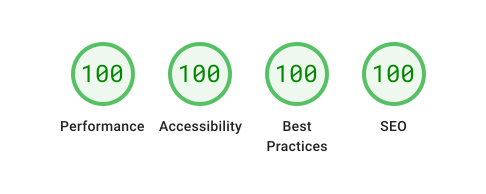
The site launched with perfect Lighthouse scores across all four categories. The founder edits content directly through Strapi without needing me. Hosting and database costs sit at around £7 a month, plus the domain renewal once a year. The Wix subscriptions he'd been paying for (a two-year Premium plan and a monthly business email add-on) were no longer needed and could be cancelled.

The handover was complete: he owns every account, every credential, every repo. A client-facing guide covers how to edit content, check form submissions, and what not to touch, with a CMS formatting reference as an appendix. The GitHub main branch is protected with rulesets so future contributors can't force-push or bypass pull requests.
Building a brand and site a solo founder can run himself
Perfect Lighthouse score across Performance, Accessibility, Best Practices, and SEO.
What I took from it

The first session is the most expensive one to skip.

Sitting down to understand the business before opening a design file is the part most freelance briefs cut. It's also the part that makes the rest fast. By the time I started designing, the visual language already had a brief. Not from me, from the conversation we'd had about who his clients were. Most of the work after that was execution, not invention.

The engagement model is the case study. Research first, then design, then build, then hand it over completely. A founder shouldn't have to keep paying to keep their own site alive, and they shouldn't need to call you to change a heading.

Share on LinkedIn

Other projects

Component Lab: a visual workspace for shadcn

Browse, edit, or build from scratch. Four weeks of solo design and build, with AI as engineering partner.

Building a product from scratch at an early-stage startup

Eleven months at a remote AI startup, first designer in. From no brand or UI to a shipped product with a successful pilot demo.

Designing my portfolio like a product

A new portfolio site, designed and built with the same care I'd give any other product brief.

Reducing churn for a global subscription service

10 weeks on a churn problem. Three concept directions, 15 international interviews on the most testable one, and a printer of our own to walk the customer journey end to end.

A better comparison slider for mobile

The comparison slider is one of the more useful components on this site. On mobile, it has two problems that quietly undermine the whole point of it.

Designing a smarter GenAI workflow for AI developers

Three iterations, 32 international users, and a product that stopped being a separately-named add-on along the way.

Building a scalable design system for a global risk platform

Four weeks to audit, build, and document. Dataviz built in as a first-class subsystem, not an afterthought.

Optimising the digital shopping experience for a home improvement retailer

A 3-week diagnostic across paint, kitchen, and timber. 153 ranked usability issues, four strategic questions, and Figma design variants for each.

Validating demand for a low-cost learning device in India

A fake brand, real ads, and two weeks of live testing. What people want and what they'll pay for aren't the same number.

Cutting through the noise with short-form sales content

Eleven short videos to dispel myths about a managed services product, built to travel across markets, languages, and attention spans.

Understanding a diverse diaspora audience

Ten interviews and four personas to help a community organisation see its audience more honestly.

Component Lab: a visual workspace for shadcn

Browse, edit, or build from scratch. Four weeks of solo design and build, with AI as engineering partner.

Building a product from scratch at an early-stage startup

Eleven months at a remote AI startup, first designer in. From no brand or UI to a shipped product with a successful pilot demo.

Designing my portfolio like a product

A new portfolio site, designed and built with the same care I'd give any other product brief.

Reducing churn for a global subscription service

10 weeks on a churn problem. Three concept directions, 15 international interviews on the most testable one, and a printer of our own to walk the customer journey end to end.

A better comparison slider for mobile

The comparison slider is one of the more useful components on this site. On mobile, it has two problems that quietly undermine the whole point of it.

Designing a smarter GenAI workflow for AI developers

Three iterations, 32 international users, and a product that stopped being a separately-named add-on along the way.

Building a scalable design system for a global risk platform

Four weeks to audit, build, and document. Dataviz built in as a first-class subsystem, not an afterthought.

Optimising the digital shopping experience for a home improvement retailer

A 3-week diagnostic across paint, kitchen, and timber. 153 ranked usability issues, four strategic questions, and Figma design variants for each.

Validating demand for a low-cost learning device in India

A fake brand, real ads, and two weeks of live testing. What people want and what they'll pay for aren't the same number.

Cutting through the noise with short-form sales content

Eleven short videos to dispel myths about a managed services product, built to travel across markets, languages, and attention spans.

Understanding a diverse diaspora audience

Ten interviews and four personas to help a community organisation see its audience more honestly.